
Class 7 Worksheet on Prefix and Suffix Use

Class 7 Worksheet on Prefix and Suffix Use
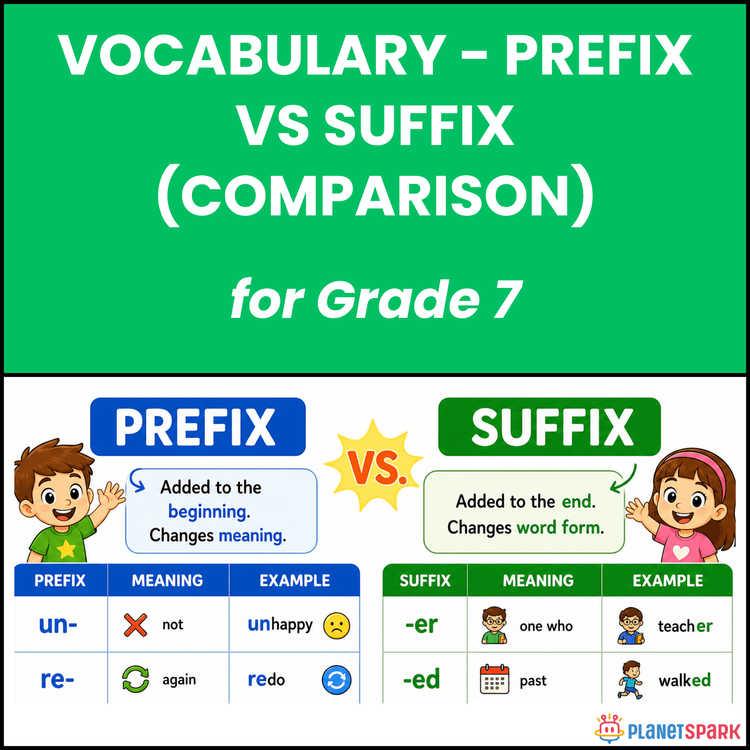
Prefix vs Suffix Mastery: Understanding Word Formation for Class 7
This Grade 7 worksheet helps students clearly understand the difference between prefixes and suffixes and how they change word meanings and forms. By comparing both concepts through structured exercises, learners develop stronger vocabulary skills and improve their ability to identify how words are built. The worksheet focuses on real examples like unhappy, rewrite, hopeful, and kindness to build practical understanding.
Why Prefix vs Suffix Understanding Matters?
Understanding the difference between prefixes and suffixes is essential for vocabulary development. For Grade 7 learners, this topic is important because:
1. It helps students identify where word parts are added (beginning vs end).
2. It improves word formation and meaning recognition.
3. It strengthens grammar and sentence accuracy.
4. It builds confidence in decoding unfamiliar words.
What’s Inside This Worksheet?
This worksheet includes five structured activities to build strong word formation skills:
🧠 Exercise 1 – True or False
Students identify whether statements about prefixes and suffixes are correct.
📋 Exercise 2 – Sort the Words
Students classify words into prefix-based and suffix-based categories.
✏️ Exercise 3 – Fill in the Blanks
Students choose the correct word form to complete each sentence.
🧠 Exercise 4 – Multiple Choice Questions
Students select correct meanings and identify prefixes and suffixes.
📝 Exercise 5 – Sentence Rewriting
Students correct incorrect statements about prefixes and suffixes.
This worksheet helps your child clearly understand word structure and improve vocabulary accuracy through comparison-based learning.
✅ Answer Key (For Parents & Educators)
Exercise 1 – True or False
1. True
2. True
3. False
4. False
5. True
6. False
7. True
8. True
9. False
10. False
Exercise 2 – Sort the Words
Prefix Words:
1. disagree
2. impossible
3. preview
4. unhappy
5. rewrite
6. preheat
7. incorrect
8. undo
Suffix Words:
1. kindness
2. agreement
3. teacher
4. slowly
5. hopeful
6. helpful
7. fearless
Exercise 3 – Fill in the Blanks
1. rewrite
2. unhappy
3. teacher
4. preview
5. skillful
6. disagree
7. colorful
8. agreement
9. undo
10. incorrect
Exercise 4 – Multiple Choice Questions
1. d) unhappy
2. b) person
3. d) helpful
4. c) re
5. b) unhappy
6. c) ness
7. d) helpful
8. b) dis
9. c) quickly
10. d) before
Exercise 5 – Sentence Rewriting
1. A prefix comes at the start of a word.
2. A suffix comes at the end of a word.
3. Unhappy uses a prefix.
4. Teacher uses a suffix.
5. Rewrite means write again.
6. Kindness ends with the suffix ness.
7. Preview means seeing before an event.
8. Hopeful means full of hope.
9. Disagree means having a different opinion.
10. Slowly means in a slow way.
Help your child master word formation and clearly understand prefixes and suffixes with structured comparison practice today.
🔖Book a free trial!
Frequently Asked Questions
They help students understand word formation patterns, improving vocabulary recognition and clearer sentence understanding in Class 7 English practice.
Because both change words, children may forget that prefixes come before and suffixes come after the base word.
They can use simple examples like happy, unhappy, and happiness to show how word meaning and form change.