
Class 7 Worksheet on Derivational Morphology

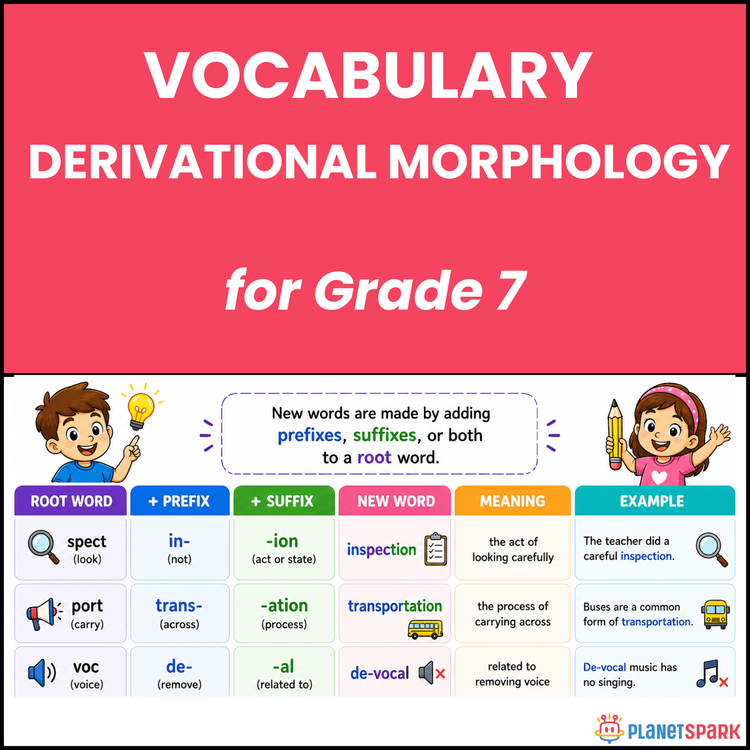
Class 7 Worksheet on Derivational Morphology
Word Builders in Action: Mastering Derivational Morphology for Class 7
This Grade 7 worksheet focuses on derivational morphology, helping students understand how new words are formed using prefixes and suffixes. Through structured and engaging exercises, learners explore how base words change into nouns, adjectives, and verbs using derivation rules.
Why Derivational Morphology Matters in Grammar?
Understanding derivational morphology is essential for vocabulary growth and language precision. For Grade 7 learners, this topic is important because:
1. It helps students identify root words and their related forms.
2. It improves spelling and word formation skills.
3. It enhances reading comprehension by decoding unfamiliar words.
4. It supports better writing by expanding vocabulary usage.
What’s Inside This Worksheet?
This worksheet includes five grammar-focused exercises that strengthen understanding of derivational word forms:
🧠 Exercise 1 – True or False
Students evaluate statements about prefixes, suffixes, and word formation rules to build conceptual clarity.
✏️ Exercise 2 – Sort the Words
Learners classify words into prefix-based and suffix-based derivations, reinforcing structural understanding.
📋 Exercise 3 – Fill in the Blanks
Students choose the correct derived word to complete meaningful sentences using contextual clues.
📝 Exercise 4 – Multiple Choice Questions
A set of MCQs tests knowledge of base words, prefixes, suffixes, and correct derivations.
🔁 Exercise 5 – Sentence Rewriting
Students correct incorrect statements by applying accurate derivational rules and meanings.
✅ Answer Key (For Parents & Educators)
Exercise 1 – True or False
1. True
2. True
3. False
4. True
5. True
6. False
7. False
8. False
9. False
10. True
Exercise 2 – Sort the Words
Prefix Change: preview, unhappy, rewrite, disagree, preheat, impossible, inactive
Suffix Change: writer, teacher, happiness, helpful, careful, successful, fearless, creative
Exercise 3 – Fill in the Blanks
1. happiness
2. teacher
3. nervous
4. creativity
5. rewrite
6. helpful
7. bravery
8. achievement
9. creative
10. incorrect
Exercise 4 – Multiple Choice Questions
1. b) happiness
2. a) teach
3. c) unhappy
4. a) beauty
5. b) helpful
6. a) brave
7. c) unhappy
8. c) ive
9. d) successful
10. d) in
Exercise 5 – Sentence Rewriting
1. Happiness comes from the word happy.
2. Teacher comes from the word teach.
3. Careful is formed by adding a suffix.
4. Unhappy means not happy.
5. Beautiful comes from the word beauty.
6. Bravery is formed by adding the suffix -ery.
7. Rewrite means write again.
8. Creative comes from the word create.
9. Helpful means full of help.
10. Successful and success are related words.
Boost your child’s vocabulary power and word-building confidence with expert-led learning sessions tailored for real results.
🔖Book a free trial!
Frequently Asked Questions
It teaches students how words change into new forms, helping them understand deeper word relationships and stronger reading comprehension skills.
Because spelling and meaning may both change, students need practice recognizing patterns between base words and derived forms.
They can ask children to transform simple words into new forms like act, action, and active for regular vocabulary practice.