
Class 7 Worksheet on Compare and Contrast

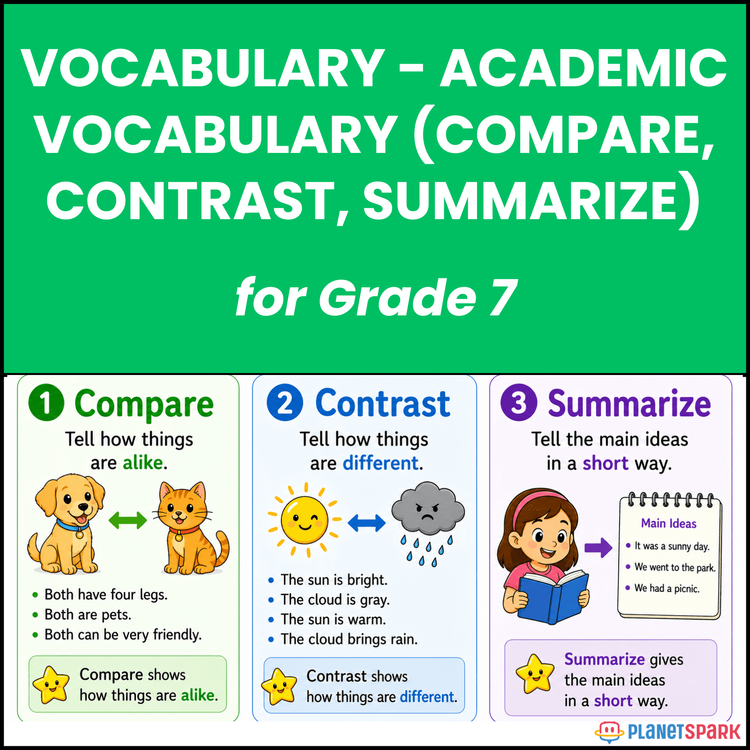
Class 7 Worksheet on Compare and Contrast
Think Clearly: Compare, Contrast & Summarize Vocabulary for Class 7
This Grade 7 worksheet focuses on academic vocabulary used for comparing, contrasting, and summarizing ideas—three essential skills in reading and writing. Students work with words like “similar,” “different,” “however,” and “summary” to understand how ideas are connected, distinguished, and condensed. Through structured exercises, learners develop the ability to identify similarities, highlight differences, and express main ideas effectively.
Why Compare, Contrast & Summarize Matter in Grammar?
These skills go beyond vocabulary—they shape how students think and communicate. For Grade 7 learners, this topic is important because:
1. It helps students analyze similarities and differences between ideas.
2. It improves reading comprehension and critical thinking.
3. It builds the ability to express key ideas concisely.
4. It strengthens structured writing in answers and essays.
What’s Inside This Worksheet?
This worksheet includes five structured exercises that build clarity and application:
🧠 Exercise 1 – True or False
Students evaluate statements about compare, contrast, and summarize, identifying correct meanings and misconceptions (page 3).
✏️ Exercise 2 – Sort the Words
Learners classify vocabulary into comparison and contrast categories:
Compare Words:
- same
- similar
- alike
- both
- common
- share
- similarly
Contrast Words:
- different
- unlike
- however
- but
- although
- while
- contrast
- difference
📋 Exercise 3 – Fill in the Blanks
Students choose the correct word to complete sentences, applying compare, contrast, and summarize vocabulary in context (page 5).
📝 Exercise 4 – Multiple Choice Questions
MCQs test understanding of meanings, usage, and connectors that indicate similarity or difference (pages 6–7).
🔁 Exercise 5 – Sentence Rewriting
Students correct incorrect definitions and reinforce accurate understanding of academic vocabulary (page 8).
✅ Answer Key (For Parents & Educators)
Exercise 1 – True or False
1. True
2. True
3. True
4. False
5. False
6. False
7. True
8. True
9. False
10. False
Exercise 2 – Sort the Words
Compare Words:
- same
- similar
- alike
- both
- common
- share
- similarly
Contrast Words:
- different
- unlike
- however
- but
- although
- while
- contrast
- difference
Exercise 3 – Fill in the Blanks
1. compare
2. contrast
3. summarize
4. similar
5. alike
6. different
7. analyze
8. contrast
9. summary
10. contrast
Exercise 4 – Multiple Choice Questions
1. a) find similarities
2. b) find differences
3. a) give main idea briefly
4. c) both
5. d) however
6. c) compare
7. b) contrast
8. b) summary
9. c) different
10. d) however
Exercise 5 – Sentence Rewriting
1. Compare means to find similarities between things.
2. Contrast means to find differences between things.
3. Summarize means to give the main idea briefly.
4. Similar means almost the same.
5. Unlike means not the same.
6. Readers compare characters by finding similarities and differences.
7. Summary means writing the main idea briefly.
8. However is used to show contrast or difference.
9. Different means not the same.
10. Contrast means to identify differences clearly.
Help your child develop strong analytical and writing skills by mastering how to compare, contrast, and summarize effectively.
🔖Book a free trial!
Frequently Asked Questions
They help students explain similarities and differences clearly, improving reading comprehension and stronger writing structure in CBSE English learning.
Words like both, however, and unlike help students organize ideas logically and make comparisons easier for readers to understand.
They can compare two books, people, or places using linking words to strengthen vocabulary and analytical thinking naturally.