
Grade 4 Worksheet on Suffixes (-er as Person)

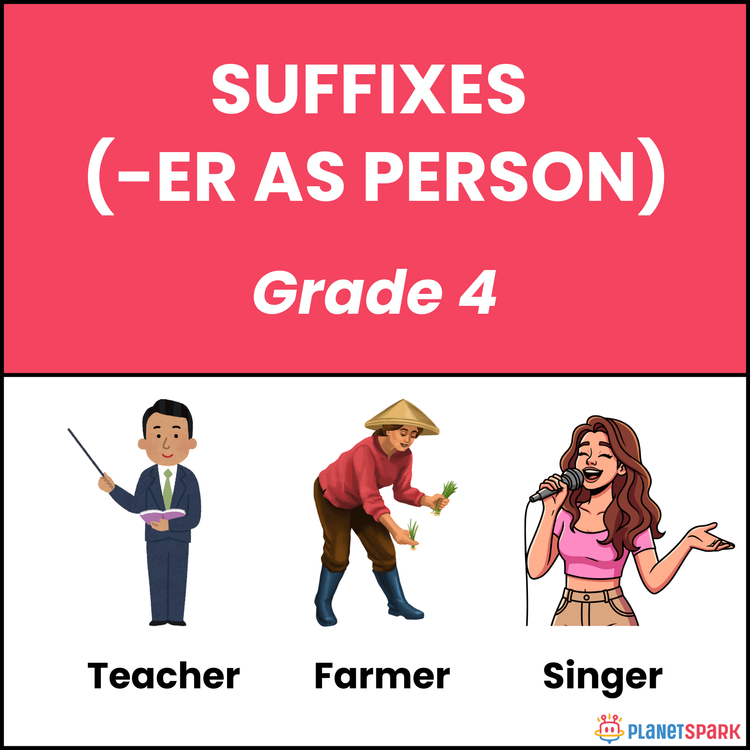
Grade 4 Worksheet on Suffixes (-er as Person)
Become a Grammar Pro: Mastering the Magic of -er Suffixes for Grade 4!
A Grade 4 worksheet designed to help students understand how the suffix -er is used to form nouns that represent people or jobs. This worksheet provides engaging, practical activities aimed at enhancing grammar skills. Tasks include sorting words with the -er suffix, filling in the blanks with the correct -er word, and writing sentences using new vocabulary. A hands-on approach to mastering grammar, this worksheet ensures students can confidently identify and use the -er suffix in real-life contexts.
Why Suffixes Matter in Grammar?
Suffixes like -er help shape meaning in language by turning verbs into nouns that describe people or jobs. For Grade 4 learners, this topic is essential because:
1. Suffixes build vocabulary and understanding of word formation.
2. They help create more specific nouns that are easier to understand.
3. Using the correct suffix leads to better sentence structure and clarity in communication.
What’s Inside This Worksheet?
This worksheet includes five grammar-rich activities that build fluency with the -er suffix:
Exercise 1 – True or False
Students read sentences and decide if they are true or false regarding professions with the -er suffix.
Exercise 2 – Sort the Words
Students categorize words into -er person words and non-er words.
Exercise 3 – Fill in the Blanks
Students choose the correct -er word to complete sentences.
Exercise 4 – Multiple Choice
Students select the correct word form to complete each sentence.
Exercise 5 – Write a Sentence
Students use the given -er words in sentences to reinforce their understanding.
Answer Key (For Parents and Educators)
Exercise 1 – True or False
1. T
2. T
3. F (Painter is a person who paints.)
4. T
5. T
6. F (Teacher is a person who teaches students.)
7. F (Trainer is a person who trains, not takes training.)
8. T
9. F (An officer is a person who works in an office, not ‘offices’.)
10. F (Speaker is a person who speaks, not uses a speaker.)
Exercise 2 – Sort the Words
-er person words: gardener, climber, manager, observer, researcher, explorer, listener, helper, worker
Non-er person words: visitor, instructor, actor, inventor, sailor, director
Exercise 3 – Fill in the Blanks
1. explorer
2. owner
3. swimmer
4. skater
5. builder
6. designer
7. baker
8. officer
9. drummer
10. preacher
Exercise 4 – Multiple Choice Questions
1. b) teacher
2. a) observer
3. d) dancer
4. a) manager
5. c) rescuer
6. b) researcher
7. c) runner
8. d) climber
9. b) singer
10. c) driver
Exercise 5 – Write a Sentence Using the Given Word (Answers may vary)
1. Teacher – The teacher helped us understand the lesson.
2. Driver – The driver took us to the airport safely.
3. Photographer – The photographer captured beautiful moments at the wedding.
4. Speaker – The speaker gave an inspiring speech at the conference.
5. Painter – The painter created a masterpiece for the gallery.
6. Writer – The writer published a novel that became a bestseller.
7. Climber – The climber reached the summit of the mountain.
8. Farmer – The farmer grows fresh vegetables for the market.
9. Plumber – The plumber fixed the leaky pipe in our house.
10. Jogger – The jogger runs every morning to stay fit.
Help your child master suffixes today with a Free 1:1 Communication Skills Trial Class at PlanetSpark.
Frequently Asked Questions
-Er' is added to verbs to form nouns that describe a person or thing doing the action, like 'teacher' or 'worker'.
By identifying common verbs and adding '-er', like 'bake' to 'baker' and 'run' to 'runner'.
It helps children understand the connection between verbs and people or things that perform the actions.