
Grade 4 Grammar Worksheet on Prefixes (bi-, tri-)

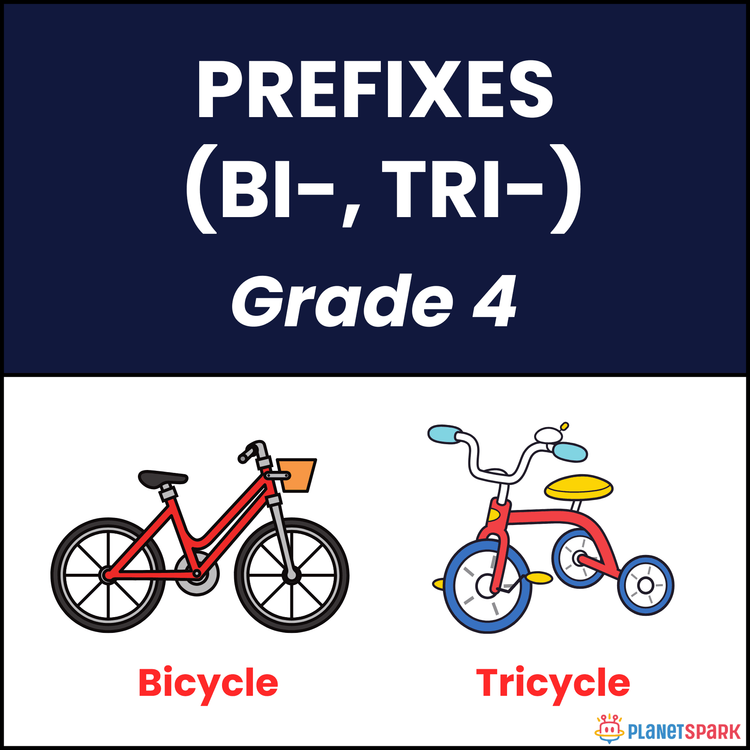
Grade 4 Grammar Worksheet on Prefixes (bi-, tri-)
Prefixes (bi-, tri-) for Grade 4: Building Strong Grammar Skills
This Grade 4 worksheet focuses on the prefixes bi- and tri-, providing engaging activities to help students understand the meaning and usage of these prefixes in words. Students will explore the concepts of bi- (meaning "two") and tri- (meaning "three"), and practice applying them in various contexts. They gain hands-on experience in recognizing and forming words with these prefixes, strengthening their grammar skills in an age-appropriate and engaging way.
Why Prefixes Matter in Grammar?
Prefixes are essential for building a strong vocabulary and improving language comprehension. They provide clues to the meanings of words and make it easier to understand new words. For Grade 4 learners, learning about bi- and tri- prefixes:
1. Helps children understand the number-related meanings (e.g., two, three).
2. Enhances their ability to decode unfamiliar words.
3. Develops their ability to use these prefixes correctly in speaking and writing.
What’s Inside This Worksheet?
This worksheet includes five grammar-rich activities that build fluency with prefixes bi- and tri-:
Exercise 1 – True/False Questions
Students read statements and identify if they are true or false, providing corrections where needed. This exercise reinforces their understanding of common words with bi- and tri- prefixes.
Exercise 2 – Sort the Words
Students categorize words with bi- and tri- prefixes into separate groups, further helping them distinguish between words with these prefixes.
Exercise 3 – Fill in the Blanks
Students complete sentences by filling in the blanks with appropriate bi- and tri- words. This encourages practical application of the prefixes in context.
Exercise 4 – Multiple Choice Questions
Students choose the correct prefix to complete words based on the meaning of the sentence. This section tests their knowledge and understanding of both prefixes.
Exercise 5 – Sentence Writing
Students create sentences using words with bi- and tri- prefixes. This helps them to contextualize the words and apply their learning in writing.
Answers (For Parents and Educators)
Exercise 1 – True/False
1. T
2. F – A tricycle has three tyres.
3. F – Biweekly means once every two weeks.
4. T
5. F – Trilingual means knowing three languages.
6. T
7. T
8. F – Trimonthly means every three months.
9. F – A tripod has three legs.
10. T
Exercise 2 – Sort the Words into bi- and tri- groups
bi- tri-
bicentury triplet
bipedal trisect
bipolar triad
bipteral triathlete
bifurcated trilogy
bivalve tricycle
bimonthly triannual
bipartisan
Exercise 3 – Fill in the blanks with bi- or tri- words
1. bifocal
2. triennial
3. bilingual
4. tricolour
5. bisect
6. triathlon
7. triceps
8. trio
9. biplane
10. bicolour
Exercise 4 – Choose the correct bi- or tri- word
1. b) bilingual
2. d) triple
3. b) bipolar
4. a) tripod
5. c) triceratops
6. a) bimester
7. d) triplet
8. c) triangle
9. a) bilateral
10. d) bicentennial
Exercise 5 – Sample Sentences
1. I saw a triangle in the drawing class.
2. The flag was a tricolour design.
3. Our meeting happens biweekly.
4. I rode my bicycle to school.
5. He set up a tripod for the camera.
6. The book series is a trilogy.
7. You need to bisect the pizza.
8. The band performed as a trio.
9. A biped walks on two legs.
10. Our newsletter arrives bimonthly.
Help your child master prefixes today with a Free 1:1 Grammar Skills Trial Class at PlanetSpark.
Frequently Asked Questions
Bi-' means two, and 'tri-' means three, changing words like 'bicycle' (two wheels) or 'triangle' (three sides).
Use real-life examples and visuals like pictures of a bicycle or a triangle to reinforce these prefixes.
They allow students to understand and recognize many new words with 'bi-' and 'tri-' in them.