
Grade 4 Grammar Worksheet on Antonyms for Feelings

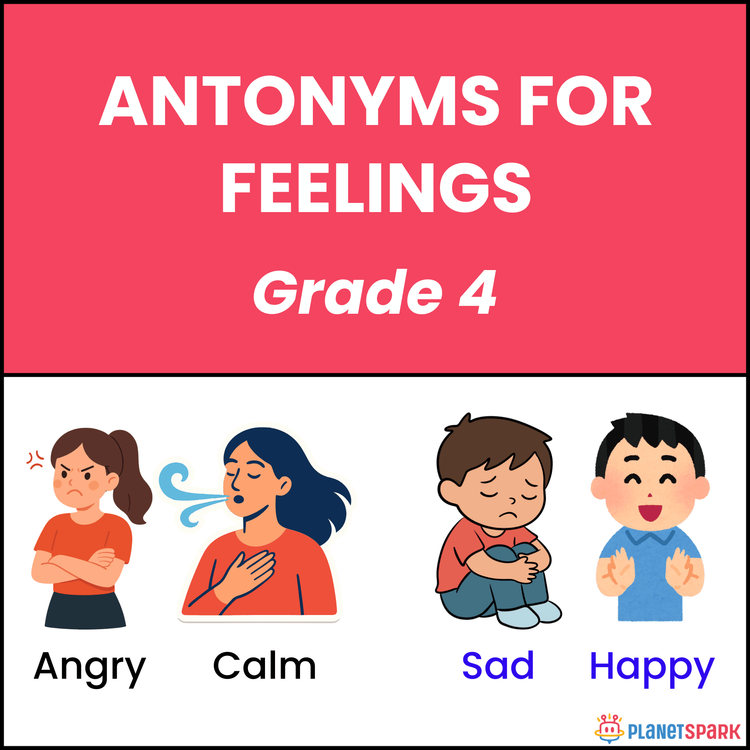
Grade 4 Grammar Worksheet on Antonyms for Feelings
Antonyms for Feelings: Exploring Emotions for Grade 4
This Grade 4 worksheet focuses on antonyms of feelings, helping students develop their vocabulary and understanding of opposite emotions. With a mix of activities like True/False, Sorting Word Pairs, Fill in the Blanks, Multiple Choice Questions, and Sentence Writing, this worksheet offers a well-rounded approach to learning.
Why Antonyms Matter in Grammar?
Understanding antonyms is a critical part of grammar because:
1. They help students grasp the concept of opposites, an essential element in constructing varied sentences.
2. Antonyms encourage a deeper understanding of how words relate to one another, aiding both speaking and writing fluency.
3. They also contribute to more precise communication, as students can more effectively express contrasting emotions or ideas.
What’s Inside This Worksheet?
This worksheet includes five engaging grammar-rich activities that build fluency with antonyms for feelings:
Exercise 1 – True/False
Students read sentences and decide if they are true or false, correcting any wrong information about antonyms for emotions.
Exercise 2 – Sort the Words
Students sort pairs of words into antonyms and non-antonyms, helping them identify opposites like "cheerful/sad" and "brave/fearful".
Exercise 3 – Fill in the Blanks
Students complete sentences by choosing the correct antonym from a word bank, expanding their understanding of opposite feelings.
Exercise 4 – Multiple Choice Questions
A set of multiple-choice questions where students select the antonyms for emotions like "joyful", "cowardly", and "accept".
Exercise 5 – Sentence Writing with Antonyms
Students write sentences using antonyms of feelings in context, reinforcing their understanding through creative practice.
This worksheet is a great way for Grade 4 students to expand their understanding of emotions and improve their language skills. It's perfect for students working to strengthen their vocabulary and writing abilities in a fun and engaging way.
Answer Key (For Parents and Educators)
Exercise 1 – True/False
1. True
2. False – Worried and calm do not mean the same.
3. True
4. True
5. False – Proud means feeling confident
6. True
7. False – Kind and cruel are antonyms.
8. True
9. False – Confident and unsure do not have similar meanings.
10. False – Excited means the opposite of feeling bored.
Exercise 2 – Sorting Word Pairs
Antonyms:
- good/evil
- sharp/dull
- early/late
- bold/timid
- angry/calm
- cheerful/sad
- kind/cruel
- up/down
Not Antonyms:
- big/large
- small/tiny
- begin/start
- brave/bold
- quick/fast
- sad/gloomy
- ill/sick
Exercise 3 – Fill in the Blanks
1. upset
2. clean
3. quiet
4. selfish
5. proud
6. defeat
7. weak
8. modern
9. narrow
10. rude
Exercise 4 – Multiple Choice Questions
1. b) sad
2. a) brave
3. c) careful
4. b) hopeless
5. d) lonely
6. c) reduce
7. c) dim
8. a) refuse
9. d) light
10. a) failure
Exercise 5 – Sentence Writing with Antonyms
1. The test was very difficult.
2. It is unsafe to play here.
3. I am uncertain of my name.
4. Ravi was late for the party.
5. Asha was kind to her friend.
6. The cake tasted sour.
7. My shirt is completely wet.
8. Meera felt joyful at the fair.
9. My dog is very disobedient.
10. They were generous in the game.
Help your child master antonyms for feelings today with a Free 1:1 Communication Skills Trial Class at PlanetSpark.
Frequently Asked Questions
Antonyms help children recognize the opposite of emotions, such as 'happy' and 'sad'.
Use real-life examples and contrasting feelings to help children connect opposites, like 'angry' vs. 'calm'.
They expand a student's emotional vocabulary, enabling them to describe emotions more accurately.