Class 4 Synonyms for Everyday Words Worksheet
Class 4EnglishEnglish GrammarFree DownloadPDF

Archita SrivastavaVisit Profile
I am a lively and dynamic educator with four years of teaching experience across online and offline classrooms. I began my journey as a private tutor for three years and currently work as a Public Speaking Expert at PlanetSpark. I have taught students up to high school in CBSE, ICSE, and UP Board, covering all major subjects while guiding them through board exam projects and assignments with creativity, confidence, and a joyful learning spirit. My aim is to build confident speakers and motivated learners who grow with curiosity and joy.
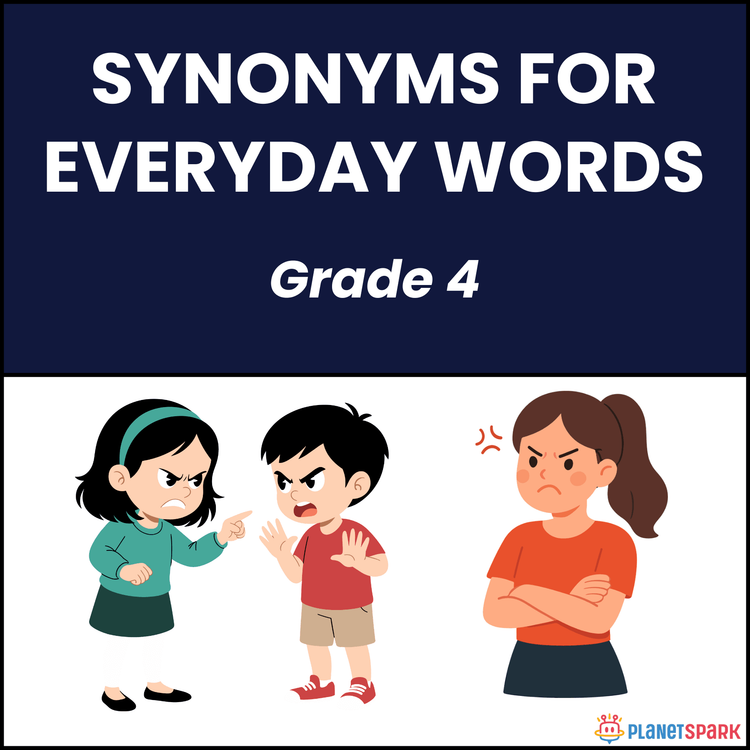
Class 4 Synonyms for Everyday Words Worksheet
Class 4EnglishEnglish GrammarFree DownloadPDF
Archita SrivastavaVisit Profile
I am a lively and dynamic educator with four years of teaching experience across online and offline classrooms. I began my journey as a private tutor for three years and currently work as a Public Speaking Expert at PlanetSpark. I have taught students up to high school in CBSE, ICSE, and UP Board, covering all major subjects while guiding them through board exam projects and assignments with creativity, confidence, and a joyful learning spirit. My aim is to build confident speakers and motivated learners who grow with curiosity and joy.
Say It Better: Synonyms for Everyday Words for Class 4
This Grade 4 worksheet helps students level up their vocabulary by replacing common, overused everyday words with stronger, more expressive synonyms. By swapping weak words like good, bad, said, big, small, nice, angry, happy, walk, and look with vivid alternatives like excellent, awful, replied, huge, tiny, pleasant, furious, delighted, stroll, and glance, Class 4 learners discover how choosing the right word makes their writing more powerful, precise, and engaging.
Why Do Synonyms for Everyday Words Matter in Grammar?
Building a stronger vocabulary by upgrading everyday words is a key language skill for Grade 4 students. It is important because:
1. It teaches students that not all synonyms carry the same strength — some words are more vivid, specific, and impactful than others.
2. It helps move writing beyond simple, repetitive words like good or said, making sentences richer and more expressive.
3. It improves reading comprehension by helping learners understand and use a wider range of words in context.
4. It builds confidence in both spoken and written communication, preparing students for more advanced English tasks.
What's Inside This Worksheet?
This worksheet includes five well-structured activities that build synonym recognition and the ability to choose stronger, more expressive words in a variety of sentence contexts:
Exercise 1 – Match the Following
Students match each common everyday word on the left to its stronger synonym from the pool on the right. Words like good, bad, said, big, small, nice, angry, happy, walk, and look are matched to excellent, awful, replied, huge, tiny, pleasant, furious, delighted, stroll, and glance. This activity helps students instantly connect weak words with their more expressive alternatives.
Exercise 2 – Sort the Words
Students sort given word pairs into two groups — Synonym (the two words mean the same thing) and Not Synonym (the two words are unrelated). Pairs like good/excellent, bad/awful, said/replied, big/huge, small/tiny, nice/pleasant, angry/furious, happy/delighted, walk/stroll, and look/glance are synonyms, while pairs like pen/eraser, rice/water, train/bus, door/window, and shirt/shoe are not synonyms.
Exercise 3 – Fill in the Blanks
Students select the stronger synonym from a given pair to complete each sentence. With 10 contextual sentences featuring familiar Indian cities and names like Rahul, Diya, Neha, Kartik, Pooja, and Rohan set across cities like Jaipur and Mumbai, this exercise makes learning relatable and practical for Class 4 learners.
Exercise 4 – Multiple Choice Questions
Students choose the best stronger synonym from four options for each common word. With 10 questions across two pages, this activity builds vocabulary depth and exam-style confidence in selecting the most expressive word for a given context.
Exercise 5 – Sentence Rewriting
Students rewrite 10 given sentences by replacing a weak everyday word with its stronger synonym. Set in vivid Indian contexts — from a movie in Mumbai to a bus at Pune station — this task challenges learners to apply their vocabulary knowledge meaningfully in writing.
Answer Key (For Parents & Educators)
Exercise 1 – Match the Following
good → excellent
bad → awful
said → replied
big → huge
small → tiny
nice → pleasant
angry → furious
happy → delighted
walk → stroll
look → glance
Exercise 2 – Sort the Words
Synonym:
good/excellent
bad/awful
said/replied
big/huge
small/tiny
nice/pleasant
angry/furious
happy/delighted
walk/stroll
look/glance
Not Synonym:
pen/eraser
rice/water
train/bus
door/window
shirt/shoe
Exercise 3 – Fill in the Blanks
1. excellent (excellent / pleasant)
2. awful (awful / tiny)
3. replied (replied / glance)
4. huge (huge / awful)
5. tiny (tiny / stroll)
6. pleasant (pleasant / furious)
7. furious (furious / delighted)
8. delighted (delighted / replied)
9. stroll (stroll / huge)
10. glance (glance / excellent)
Exercise 4 – Multiple Choice Questions
1. c) excellent
2. a) awful
3. a) replied
4. c) huge
5. d) pleasant
6. b) furious
7. a) delighted
8. c) stroll
9. b) glance
10. d) tiny
Exercise 5 – Sentence Rewriting
1. The movie in Mumbai was excellent today.
2. Rahul had an awful day at school in Delhi.
3. Diya replied to the teacher in class.
4. A huge bus stopped at the Pune station.
5. A tiny ant crossed my shoe this morning.
6. Neha wore a pleasant dress to the function.
7. Kartik was furious after the foul in game.
8. Pooja felt delighted when she got her prize.
9. Rohan will stroll to the market this evening.
10. Please glance at the notice on the board.
Help your child move beyond plain, everyday words with a Free 1:1 English Vocabulary and Grammar Trial Class at PlanetSpark — because the right word at the right time is the mark of a truly confident communicator!
Frequently Asked Questions
Synonyms replace common words with more descriptive or precise alternatives, enriching sentence structure.
Using synonyms prevents repetition and enhances writing quality, helping students perform better in CBSE English.
Words like fast (quick), good (great), and smart (clever) help make writing more interesting.