
Class 4 Grammar Worksheet on Missing Subjects

Class 4 Grammar Worksheet on Missing Subjects
Complete Every Sentence: Fixing Missing Subjects for Class 4
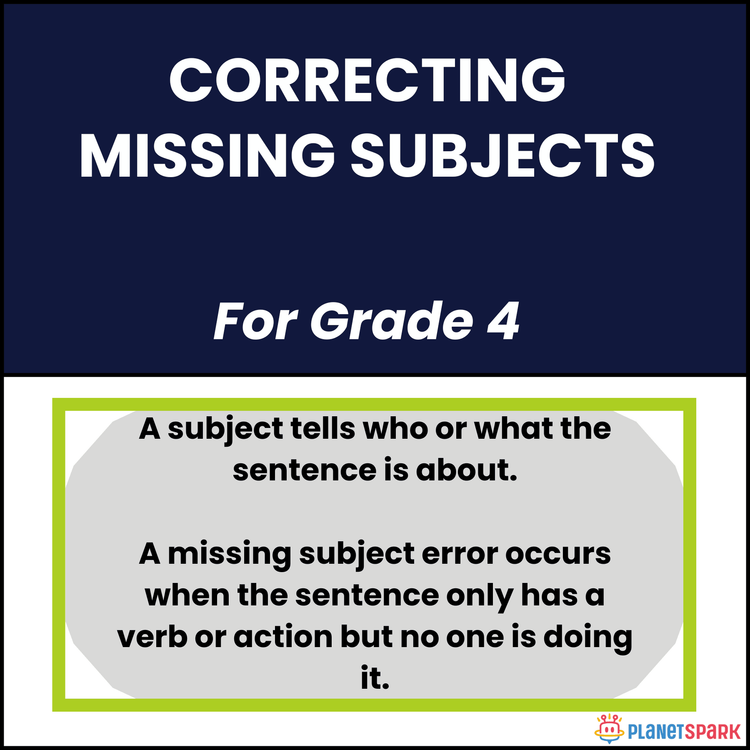
This Grade 4 grammar worksheet helps students learn how to identify and correct sentences that are missing subjects. A subject tells us who or what performs the action in a sentence. Without a subject, a sentence feels incomplete and unclear. In this worksheet, students practice recognizing sentences that begin directly with an action but do not mention who performed it.
Through engaging activities such as identifying missing subjects, choosing correct sentences in multiple-choice questions, rewriting sentences by adding suitable subjects, correcting a paragraph, and writing their own sentences, students build a strong understanding of sentence structure. These exercises help learners see how every complete sentence needs a clear subject and verb.
By completing this worksheet, Grade 4 learners strengthen their grammar foundations and improve sentence construction skills. Understanding subjects helps students write clearer sentences in stories, assignments, and everyday communication.
Why Subjects Matter in Grammar?
Subjects are an essential part of every complete sentence. They tell us who or what performs the action described by the verb. For Grade 4 learners, this topic is important because:
1. Every complete sentence must have a subject and a verb.
2. The subject tells who or what is doing the action.
3. Missing subjects make sentences incomplete or confusing.
4. Learning to add subjects helps students build clear and grammatically correct sentences.
What’s Inside This Worksheet?
This worksheet includes five grammar-rich activities that help students master sentence subjects:
🧠 Exercise 1 – Identify Missing Subjects
Students read each sentence and identify sentences that are missing a subject.
✏️ Exercise 2 – Multiple Choice: Choose the Correct Sentence
Students select the sentence that includes a clear subject and forms a complete sentence.
📋 Exercise 3 – Rewrite the Sentence
Students rewrite each sentence by adding a suitable subject to make the sentence complete.
📝 Exercise 4 – Paragraph Rewriting
Students rewrite a paragraph by adding subjects so that every sentence becomes complete.
✍️ Exercise 5 – Sentence Writing
Students write three sentences with clear subjects using correct capitalization and punctuation.
Answer Key (For Parents & Educators)
Exercise 1 – Sentences Missing a Subject
1. Went to the park in the morning.
2. Ate the cookies quickly.
3. Played the piano at school.
4. Saw a dog running across the road.
5. Read the instructions carefully.
6. Bought fruits from the stall.
7. Climbed the tall tree.
8. Went cycling in the evening.
9. Wrote a note for teacher.
10. Visited the old library.
Exercise 2 – Choose the Correct Sentence
1. a) The cat slept on the mat.
2. a) We cooked dinner together.
3. a) He drew a picture yesterday.
4. a) They ran in the playground.
5. a) She sang a song beautifully.
6. a) I watered the plants.
7. a) The boy finished homework.
8. a) We visited the museum.
9. a) He cleaned the room.
10. a) They watched a movie.
Exercise 3 – Rewritten Sentences with Subjects (Sample Answers)
1. I started reading the book.
2. I ate lunch quickly.
3. We went for a walk in the park.
4. I found a wallet on the road.
5. She danced at the school event.
6. I wrote a letter to my friend.
7. We saw fireworks last night.
8. He jumped over the puddle.
9. I watched birds in the garden.
10. We cleaned the classroom.
Exercise 4 – Corrected Paragraph (Sample)
I went to the library after school to study for the test. I found an interesting science book on the shelf. I read several pages carefully and learned many new facts. I took notes in my notebook for revision later. I met a friend near the reading table and we talked about the upcoming exam. I stayed there for an hour and finished most of my work. I returned home in the evening feeling confident about the test the next day.
Exercise 5 – Sample Sentences with Clear Subjects
1. The children played football in the playground.
2. My sister reads storybooks every night.
3. The teacher explained the lesson clearly.
Help your child build strong sentence structure and grammar confidence with expert-led English learning from PlanetSpark.
🔖Book a free trial!
Frequently Asked Questions
The subject tells who or what performs the action in the sentence.
The sentence becomes incomplete and the reader cannot understand the idea.
By checking who or what is doing the action in each sentence.