
Class 4 English Worksheet on Imperative Sentences

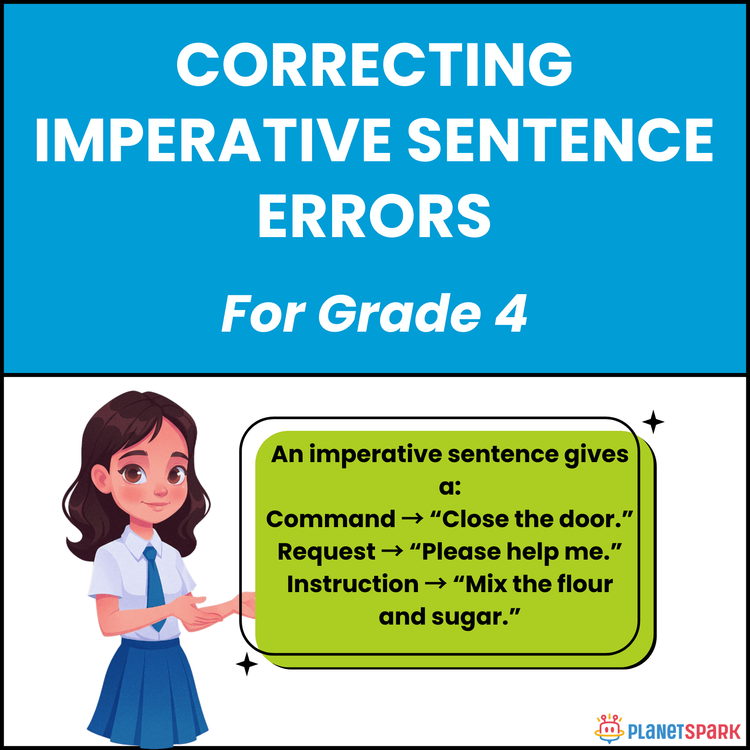
Class 4 English Worksheet on Imperative Sentences
Give Clear Instructions: Imperative Sentences for Class 4
This Grade 4 grammar worksheet helps students understand how to use imperative sentences correctly. Imperative sentences are used to give commands, instructions, requests, or advice. They usually begin with a verb and often omit the subject because it is understood to be “you.” This worksheet helps learners identify and correct mistakes in imperative sentence structures.
Through engaging grammar exercises, students practice identifying incorrect commands, choosing the correct imperative sentence from multiple options, rewriting incorrect instructions, correcting command structures in a paragraph, and creating their own polite commands. These activities help learners understand how to give clear and grammatically correct instructions.
By completing this worksheet, Grade 4 students improve their sentence construction skills and learn how to communicate instructions politely and clearly. These grammar skills support everyday classroom communication, writing tasks, and effective conversation.
Why Imperative Sentences Matter in Grammar?
Imperative sentences are commonly used to give instructions, requests, or commands. Learning how to form them correctly helps students communicate clearly. For Grade 4 learners, this topic is important because:
1. Imperative sentences usually begin with a base verb such as open, close, listen, or write.
2. The subject “you” is usually understood but not written.
3. Words like please or kindly can make commands more polite.
4. Correct imperative structure helps students follow and give instructions clearly.
What’s Inside This Worksheet?
This worksheet includes five grammar-rich activities that help students practice imperative sentences:
🧠 Exercise 1 – Identify the Incorrect Command
Students read each sentence and underline the incorrect command structure used in the sentence.
✏️ Exercise 2 – Multiple Choice: Choose the Correct Command
Students read the options carefully and select the correctly written imperative sentence.
📋 Exercise 3 – Rewrite the Command
Students rewrite incorrectly structured commands so they follow the correct imperative sentence pattern.
📝 Exercise 4 – Paragraph Correction
Students read a paragraph containing several incorrect commands and rewrite it by correcting the command structures.
✍️ Exercise 5 – Command Writing
Students write three polite commands, ensuring each sentence begins with a capital letter and ends with a full stop.
Answer Key (For Parents & Educators)
Exercise 1 – Corrected Commands
1. Please open the window.
2. Kindly pass the salt.
3. Wait here for a moment.
4. Please listen carefully.
5. Take your seat quietly.
6. Kindly close the gate.
7. Bring the notebook tomorrow.
8. Please stand in the line.
9. Finish the work quickly.
10. Kindly help your friend.
Exercise 2 – Choose the Correct Command
1. a) Close the door.
2. a) Bring some water.
3. a) Open the window.
4. a) Sit down please.
5. a) Listen carefully.
6. a) Write your name.
7. a) Stand up.
8. a) Read the book.
9. a) Clean the board.
10. a) Take your bag.
Exercise 3 – Corrected Commands
1. Please take out your books.
2. Kindly switch off the fan.
3. Please speak softly in the library.
4. Kindly open your workbook to page ten.
5. Please throw the trash in the bin.
6. Kindly follow the instructions carefully.
7. Please keep the classroom clean.
8. Kindly stand up when the teacher comes.
9. Please hold the door for others.
10. Kindly return the library book tomorrow.
Exercise 4 – Corrected Paragraph
In the classroom the teacher gave many instructions. She said, “Open your books to page twenty.” Then she told the class, “Listen carefully to the story.” After that she said, “Write the answers in your notebook.” During the activity she reminded us, “Work quietly and carefully.” When the bell was about to ring, she added, “Put your books back in the bag.”
Exercise 5 – Sample Polite Commands
1. Please keep the classroom clean.
2. Kindly complete your homework on time.
3. Please speak politely to others.
Help your child master instructions, requests, and commands while strengthening grammar and communication skills with expert-led English learning at PlanetSpark.
🔖Book a free trial!
Frequently Asked Questions
It gives commands, instructions, requests, or advice in everyday communication.
They help children understand directions and express instructions clearly.
Through English worksheets that include command and request examples.